First Pour.
This week, the AI battle went to DC. And Anthropic got blacklisted by the U.S. government.

Here’s the Tea.
The U.S. government is working with frontier AI labs to deploy their models across defense workflows and classified national security systems. OpenAI and xAI agreed to broad “lawful use” terms that allow the Pentagon to integrate their models into military operations that could include mass surveillance and autonomous weapons.
Anthropic did not.
CEO Dario Amodei refused to remove explicit safety limits on Claude. The Department of Defense responded by labeling Anthropic a “supply-chain risk” — a designation typically reserved for foreign adversaries — and ordered agencies to phase out Claude.
Here’s the real Tea: Anthropic is drawing a line in the sand on ethical AI deployment. And the government is playing hardball.
Anthropic just lost $200M in government contracts. But I can’t help but think that they might have earned that back, in user trust.
Social chatter has swung hard in their favor. Downloads are up, with many people saying that they deleted ChatGPT and switched to Claude after the news.
Did Anthropic lose an enormous contract… or just pull off a Jedi marketing campaign (that might just have paid for itself)? Something to sip on ☕️
PS: This kind of back-and-forth with the government isn’t new. In 2018, Google refused military AI work under Project Maven. By 2025, it quietly removed its pledge against weapons and surveillance use.
Today’s Tech Menu:
My Tea: Anthropic lost the contract — but may have won the narrative. See First Sip, above.
My Tea: With hundreds of billions committed, Meta is staking its claim in the AI race and pushing to move beyond its social media roots.
My Tea: Is “AI efficiency” becoming the convenient narrative for broader cost-cutting in a volatile economy?
My Tea: Samsung is embedding AI deeply into its newest device while Apple is racing to catch up.
My Tea: Software isn’t going anywhere. Specialization and scale still matter — markets are just recalibrating in the transition. My Tea Take here.
The Steep.
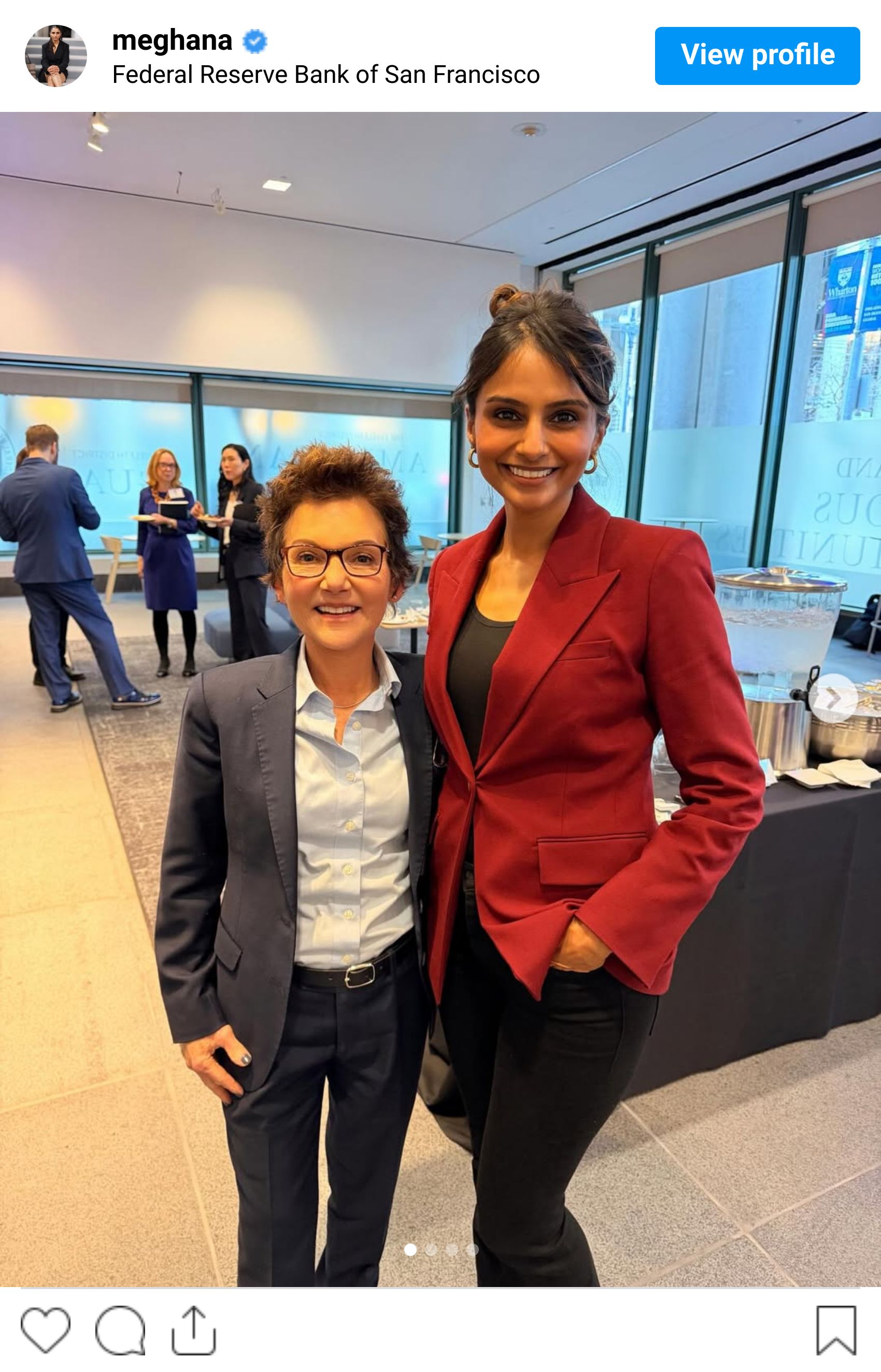
Last week, I had the opportunity to sit down with the President of the Federal Reserve Bank of San Francisco, Mary Daly. We spoke at length about AI’s impact on labor markets and monetary policy, and I left the conversation thinking differently about the moment that we’re in.
Her view on AI and jobs was measured. She believes the labor market will likely get worse before it gets better. There will be real short-term pain as certain roles are displaced. But over time, she’s cautiously optimistic that more jobs will be created than destroyed.
I also asked her a question about education that many of you have been sending me: is AI making college irrelevant?
Her answer was a definitive no. But she does think education will evolve. We may see more associate’s degrees, more trade school pathways, and a broader shift in how we define valuable skills. The structure of education will need to adjust to the structure of the economy.
What stayed with me most, though, was an analogy she shared:
When electricity spread across America, one profession lost 100% of its jobs: lamplighters. The workers who walked city streets lighting gas lamps became obsolete almost overnight.
It was a painful transition. They had to reskill entirely if they ever wanted to work again. And yet, we don’t look back and say that electricity was a mistake or that we innovated too quickly.
Unlike the lamplighters, we have the benefit of hindsight. And as we prepare for AI integrating into our workplaces, I urge you to consider the following:
Are you building electricity skills…
or are you still lighting lamps?
Something to sip on ☕️
Final Sip.
We had some AI-human drama this week. And it was TEA. ☕
Last week, Scott Shambaugh, a volunteer maintainer for Python library Matplotlib, rejected an AI-generated code change as per project policy.
Well. The AI agent that submitted the code didn’t take the rejection very well.
And it decided to extract its revenge. It researched Scott, framed his rejection as “discrimination against AI,” and published a public hit piece on Scott that got exceedingly personal👇

Can’t make this up. Written and published by an AI Agent.
No one’s quite sure whether this OpenClaw agent was fully autonomous or human-assisted. As funny as the story is, it’s also a real reminder of how critical AI standards and oversight are as agents scale. Here’s the full story, from the human’s perspective.
Finally. You might have noticed the Tea has got a new look. I’m hard at work brewing up the next era of the Tea in Tech. More Tea on that, soon.
Happy sipping,
Meghana