First Pour.
In light of International Women’s Day this week, I want to highlight an emerging issue in AI: women are using AI less than men.
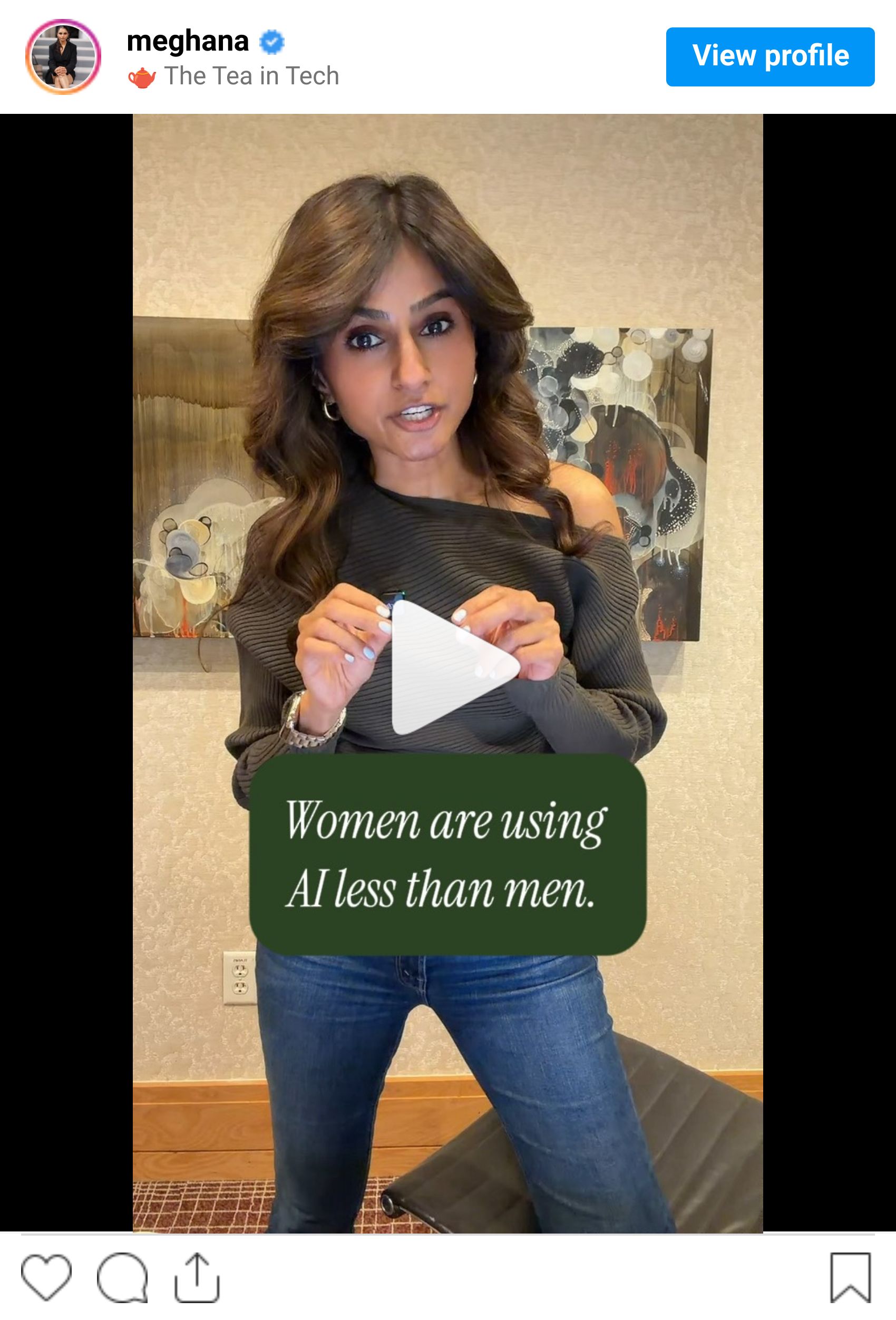
Recent research from Harvard Business Review and McKinsey found that women are adopting AI tools at lower rates in the workplace.
And honestly, the findings felt uncomfortably familiar. They reminded me of the gap we saw in STEM education in the 2000s.
I worry we may be recreating that same skills gap, in real time, with AI.
LinkedIn recently ranked AI literacy as the #1 most important skill for white-collar workers. The moment to learn these tools is now, and I believe the onus is on all of us, men and women, to build real and distributed AI fluency across our respective organizations.
Flagging this for you so that we can all examine a potential pattern here and try to interrupt it before it recurs.
Happy International Women’s Day. Let’s get you your Tech Tea. 🫖
Today’s Tech Menu:
My Tea: Anthropic might have lost a big government contract to OpenAI…but seems to have won user trust instead. Did OpenAI make the right bet?
My Tea: Important nuance…it hasn’t happened yet. The research shows no measurable spike in AI-driven unemployment. Which raises the question…are companies using AI as convenient cover for layoffs?
My Tea: This is the opening act of the AI hardware privacy debate. Imagine a world where everyone is walking around with an always-on AI recording device. Spoiler alert: the future is here.
My Tea: It’s giving…panic. Apple may be trying to lock in device revenue before AI-native hardware competition starts arriving later this year.
My Tea: This signals the industry shifting from training to inference. Translation: frontier models may be reaching maturity, and the real money now is running AI everywhere.
The Steep.
Anthropic just dropped a big report on AI and jobs, tracking which jobs are most exposed to AI disruption.
No surprises here. The roles most exposed are overwhelmingly white-collar knowledge work. Computer programmers, customer service representatives, and market research analysts rank among the top three.
Meanwhile, jobs that rely on physical work, like cooks, mechanics, and bartenders, remain among the least exposed.
Another interesting finding: workers who are most exposed to the disruption will be older, more educated, higher paid, and, interestingly, more likely to be women.
But to me, the real Tea is this:
Despite all the headlines about AI replacing workers, the researchers found no systematic increase in unemployment in these jobs since 2022.

Theoretical AI capability far exceeds actual usage today. AI is not meaningfully taking jobs right now.
When you look at the chart above, the gap is striking. AI’s theoretical capabilities far exceed how the technology is actually being used today. In other words, AI is not meaningfully taking jobs right now.
Which, then, raises an uncomfortable question: as more companies announce layoffs and point to AI as the reason…is the explanation perhaps more convenient than truthful?
Something to sip on. 🫖
Final Sip.
AI agents can think, plan, and execute tasks for us. But they can’t touch grass. To close the loop on their work, they still need one thing from us: a body.
Here’s the Tea on “Rent-a-Human,” the new platform where AI agents can hire humans to complete their tasks in the physical world. Warning: it’s weird.

Oh, and yes…she made it into a Waymo.

See you @ Tea Time next week?
Meghana